Sunday, April 6, 2014

Nuclear War, not Electricity

In case you're not sure if Iran is building the capacity for nuclear war, take a look at this 2009 article from Defense Update.  As it says:
"Iran has successfully test-fired a Sajjil-2 medium-range surface-to-surface missile, a solid-fueled missile developed in Iran..."
Solid fuel missiles are good for military work but not as good for launching satellites, where liquid fuel rockets are usually preferred.  Liquid fuel provides more thrust but takes a lot longer to set up.  Solid fuel rockets can be launched on a moments notice, a requirement for military systems.

More information on Iran's Sajjil can be found in this older Guardian piece, and this Wikipedia article.   Note that "Ahmadinejad claims the missile landed 'precisely on target'".   Only military missiles even have targets.

The payload the Sajjil can deliver is estimated at about a ton, roughly the same as the Scuds that Saddam used in the 1991 Persian Gulf War, although the Sajjil has longer range.  Those Scuds, which did not have WMD warheads, proved not to be of strategic importance.  At the size and cost of a Sajjil, it only makes sense to load them with WMDs, not regular high explosives.  The WMDs that Iran is known to be building are nuclear warheads.

These missiles aren't being made to generate electricity.

The Oil Fields are Conveniently Near the Coasts

If you study this map, you'll see that the large oil fields of Iran and Saudi Arabia are located conveniently near the Persian Gulf (also called the Arabian Gulf).  There are large oil fields in Iran, under the Gulf itself, and in Saudi Arabia.  They're all part of the same oil patch.

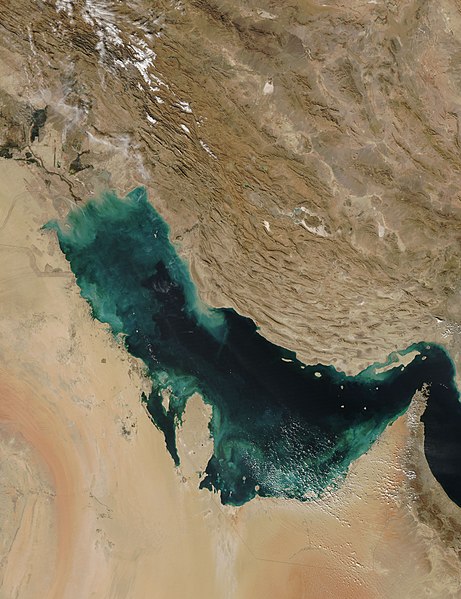
Coincidentally, CENTCOM commands the 5th fleet, whose amphibious capabilities currently include the Bataan Amphibious Ready Group(ARG), whose flagship is the USS Bataan.  I'll bet these guys have better maps of the Persian Gulf, and it's oil fields, than we do. This is an image of the Persion Gulf from outer space.


And this a fascinating more detailed version of that same image (3 megabytes).  Iran has a rougher territory than Saudi Arabia.

How Much Oil Money?

Saudi Arabia:   From a peak of $281.4bn in 2008, the Kingdoms oil revenues will dive to nearly $134.2bn in 2009 before rebounding to around $164bn in 2010, the Saudi American Bank (Samba) said in a study.

Iran: In 2007 Iran’s estimated income from exports was US$76.5 billion (free on board—f.o.b.), 85 percent of which came from petroleum and natural gas, which ends up at $65 billion for oil and gas. 

The CIA says Iran used to export 2.8 million bbl/day of oil.  It also says Saudi Arabia exports 8.2 million bbl/day.

So, to compare the 2 countries; At $50/bbl, that would be 51.1 billion dollars a year for Iran, and 149.7 billion dollars a year for Saudi Arabia.  But as we saw above, the price is not stable at $50/bbl.
These figures are not current.